
When Policy and Practice Drift Apart: Is AI Changing Who Can Challenge the Record?
AI may help workers turn a difficult experience into questions that can be examined. The test for organisations is whether those questions receive a reasoned answer.
I started The Workplace Compass because I wanted people to understand their rights and the processes available to them before they needed to use them.
That is why this question about AI matters to me.
A policy may be available to read. But when a decision affects your work, knowing how to use that policy can be much harder.
An employee may read a commitment to fairness, consistency and a chance to respond, yet still struggle to understand how it applies to a particular decision. Which version governs the process? What evidence was considered? Where does the policy allow discretion? How can an inaccurate account be corrected?
You may know what happened and still struggle to explain why it matters. Putting the records together takes time. Finding the relevant part of a policy takes more. When you are already dealing with the strain of a workplace dispute, that can be difficult to manage.
This is why I think AI deserves a closer look. If it can help an employee put events in order, compare them with the written procedure and ask a clearer question, it may give that person a better chance to be heard.
How far we can take that argument depends on what the evidence actually shows.
The distance between a concern and an answer
Knowing that something feels inconsistent is different from being able to show where the inconsistency lies.
Imagine, for example, an employee reading a decision letter alongside the procedure they thought would apply. A step appears to be missing.
The employee needs to establish what happened and ask how the decision fits the policy. Perhaps the policy allows discretion. Perhaps a different procedure applies, or there is information they have not seen. There may also be an error that needs correcting.
I use policy drift here to describe a recurring gap between the safeguards written into a policy and what happens when decisions are made. Calling it drift does not establish that anyone acted unlawfully. We still need to know the policy’s status, what discretion it allows, why a departure occurred and how it affected the employee.
The Acas Code recognises that many potential disciplinary or grievance issues can be resolved informally. Where formal action is needed, it sets out basic fairness requirements, including prompt handling, consistency, necessary investigation and an opportunity to respond. It also says employers would be well advised to keep written records. Failure to follow the Code does not, by itself, make a person or organisation liable to proceedings. A tribunal must nevertheless take the relevant provisions into account and may adjust an award by up to 25% where either party has unreasonably failed to comply. These principles matter when we ask whether a process was fair. [1]
For the employee, a reference to policy is only helpful if someone can explain how it was applied. If the organisation chose a different approach, it should be able to explain how the relevant safeguards were preserved.
What AI might change
In July 2026, Acas reported that it had adapted its advice so it could be found and accurately summarised in AI search results. This shows how Acas is responding to AI-assisted access to information. It does not tell us how many people use AI for workplace advice or whether those users secure better employment outcomes. [2]
The possible benefit is more practical and more modest. AI can help organise dates, compare passages and prepare questions. But every answer still has to be checked against the original material. The judiciary’s October 2025 guidance recognises summarisation and assistance with administrative composition as potentially useful, subject to accuracy checks. That guidance is for judicial office holders. It is not an endorsement of workplace use or any particular product. The same guidance cautions against relying on public AI tools for legal research or analysis that cannot be independently verified. [3]
What interests me is what this could mean for someone who has a concern but does not know how to put it into words. Being able to point to the record, explain what seems inconsistent and ask for an answer could make a difference.
That is a possibility we still need to test. The employee would need access to a suitable tool, the confidence to use it, reliable records and a way to check its answers. Employers can use AI too. Access to a tool alone does not put everyone on equal terms.
What the figures can tell us
Employment Tribunal statistics provide context for this discussion, but they do not measure AI’s contribution. The latest figures need to be read both against the same period last year and against the preceding quarter.
The earlier Ministry of Justice release reported approximately 15,000 single-claim receipts in January–March 2026, 50% more than a year earlier. Across financial year 2025/26, approximately 50,000 were received and 26,000 disposed of. About 64,000 single claims remained open at the end of March. [4]
The April–June release reported approximately 14,000 single-claim receipts: 28% above the same quarter a year earlier, but slightly below the preceding quarter. It also reported about 6,100 single-claim disposals and 70,000 open single claims at the end of June, 51% higher year on year and the highest level in the published series. [5]
The distinction matters. Receipts remained markedly above the year-earlier level but eased from the preceding quarter. The first half of 2026 should not be described as uninterrupted acceleration. Nor do these two quarters alone establish a permanent structural change.
Receipts continued to exceed disposals. That helps explain the accumulation of unresolved work, but not why people brought their claims. Claims are not findings of liability, and a slower quarter can still leave the system carrying a larger caseload.
The figures are rounded. HMCTS also says its continuing data-quality review estimates approximately 3% overcounting in the open caseload for single and lead multiple cases. That caveat concerns the open caseload, not receipts. [5]
Acas’s separate management-information series adds context, but it also shows why headline comparisons need care. The two series move in different directions:
Two Acas measures, two different stages
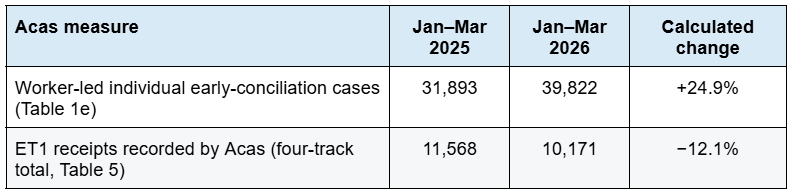
Note: Percentages are author calculations from Acas figures. These are different administrative series, not matched cohorts, and are not directly interchangeable with HMCTS statistics. They do not show whether claimants used AI or why a claim was brought. Sources: [6][7].
One series records worker-led early-conciliation cases; the other records ET1 receipts known to Acas and grouped by track. They show demand at different stages. They do not establish that AI caused more claims, exposed more wrongdoing or improved access to justice.
The inference we can—and cannot—make
Could better AI tools be helping some employees take an unresolved concern further? I think that is worth examining. Someone who can organise their records and explain the issue may find it easier to take the next step.
It may be tempting to say that single claims are rising in direct proportion to AI capability. The evidence does not allow that conclusion.
We have figures for claims, but no corresponding measure of AI capability and no evidence showing whether those claimants used it. Any association would also need to account for workplace change, awareness of rights and access to advice.
There is another possibility: clearer information could help resolve a concern earlier, or help someone recognise that a proposed claim lacks support. Better tools need not produce more claims. These are competing possibilities, not measured findings.
To find out, we would need to know which tools claimants used, when they used them, what they asked them to do and how well they worked. We would also need to compare similar disputes where AI was not used. Seeing claims rise during a period of technological change gives us a question to investigate. It does not give us the answer.
Keeping assistance accountable
This is where caution matters. AI can make an account sound settled even when the facts are not. Judicial guidance warns that it can invent authorities or quotations, state the law inaccurately and make factual errors. The person submitting the material remains responsible for it. [3]
Before asking AI to make a complaint stronger, I would ask it to help check the account. Which statements does the record support? Which are assumptions? What might support a different explanation?
Then go back to the original document. Read the date and the paragraphs around the passage. What looked like a contradiction may have an explanation in the part that was left out.
A generated summary should remain distinguishable from the source. It cannot recreate a missing original, establish someone’s motive or turn an allegation into a finding. Adding legal labels to every disagreement may make the central concern harder to examine.
Information handling comes first. If workplace material contains personal or confidential information, possessing a copy does not, by itself, determine whether it may be uploaded to an external service. Before doing so, check the applicable confidentiality, data-protection, security and workplace requirements, and disclose no more information than is necessary. The ICO’s guidance addresses security and data minimisation in AI and is currently under review following legislative change. [3][8]
If you are unsure what you are allowed to share, begin with public sources or a hypothetical question that cannot identify anyone. Do not enter patient information, legally privileged advice or confidential workplace records into an unapproved public AI tool.
Making scrutiny useful
If you are raising a concern, help the person reading it find the issue. Point to the source. Explain what seems inconsistent, what information is missing and what you want clarified or corrected.
If you are receiving that concern, its substance should still be considered on its merits. Questions about accuracy or confidentiality may also need to be addressed.
The fact that AI helped prepare a letter should not, by itself, become a reason to leave the underlying concern unexamined.
I would begin with five governance questions:
Which policy and version apply, and what discretion do they permit?
What is the process intended to do, and what consequences may follow?
Which original records support the account being relied upon?
How will a material error or disagreement be considered and answered?
Who owns the next step, and when should a response be expected?
These are practical recommendations; the legal rights attached to particular meetings and procedures vary.
Workers also need to protect applicable deadlines. An internal grievance, disciplinary process or appeal does not itself stop or extend an Employment Tribunal time limit.
Acas early conciliation can affect how the deadline is calculated. Acas states that, from 1 October 2026, the limit for most claims will increase to six months minus one day where the time limit starts on or after that date. Exact limits still depend on the claim and facts, so timely advice matters more than perfecting a chronology. [9]
An employee should not need perfect legal vocabulary to receive a reasoned answer. Equally, a well-written assertion still needs evidence.
This brings me back to why I wanted to write about these processes in the first place. If people understand what is available before the need comes, they have more opportunity to prepare.
AI may help someone find the words and organise the records. The person receiving the concern still has to listen, examine the evidence and explain the decision. Where the evidence shows an error, someone has to correct it.
A policy earns trust when the people affected by it can see how it works—and can obtain a meaningful answer when they question its application.
DISCLAIMER: This is a General educational commentary, not individual legal advice. Tribunal statistics are current to 10 September 2026 and cover Great Britain, excluding Northern Ireland.
Transparency note: This article was developed with AI-assisted research and editing. The author reviewed and approved the final text and accepts responsibility for its content.
References
1. Acas, Code of Practice on disciplinary and grievance procedures, published 11 March 2015, foreword and paragraphs 1–4. Accessed 11 September 2026.
2. Acas, Annual report reveals exceptional demand for Acas, 3 July 2026. Accessed 11 September 2026.
3. Courts and Tribunals Judiciary, Artificial Intelligence (AI): Guidance for Judicial Office Holders, 31 October 2025, sections 3.II, 3.III, 3.V, 3.VI and 4. Accessed 11 September 2026.
4. Ministry of Justice, Tribunal Statistics Quarterly: January to March 2026, 11 June 2026, section 6. Accessed 11 September 2026.
5. Ministry of Justice, Tribunal Statistics Quarterly: April to June 2026, 10 September 2026, sections 1, 2 and 6. Accessed 11 September 2026.
6. Acas, Early conciliation and employment tribunal data for England, Scotland and Wales: January to March 2026, 5 August 2026, Tables 1e and 5. Accessed 11 September 2026.
7. Acas, Method changes to early conciliation and employment tribunal data for England, Scotland and Wales: 2023 to 2024, 30 November 2023, sections 4.1 and 5.1. Accessed 11 September 2026.
8. Information Commissioner’s Office, How should we assess security and data minimisation in AI?, within Guidance on AI and data protection; currently under review following legislative change. Accessed 11 September 2026.
9. Acas, Employment tribunal time limits, last updated 4 September 2026. Accessed 11 September 2026.
