
When an Informal Process Becomes Formal
A supportive conversation can develop into a process with serious consequences. Workers should be able to understand that transition before a decision is made.
One reason I started The Workplace Compass was to help people understand workplace processes before they need to navigate them. Knowing what to ask early can make preparation more manageable.
Consider a hypothetical performance meeting. The invitation calls it informal, so you expect feedback and a conversation about support.
Then the manager refers to earlier concerns, sets a review period and mentions further action. You understand that improvement is expected. What remains unclear is whether this was ordinary supervision, the start of a formal procedure or a meeting that has already produced a warning.
The question I would ask is simple: what can be decided at this meeting?
The word informal gives us too little information on its own. A written plan also needs context. We need to know the procedure being used, the purpose of the meeting and the possible outcome.
Making room for early support
Informal management has a legitimate place in working life. A manager may need to clarify an expectation, discuss a concern or identify why someone is struggling. Workers also need opportunities to ask for help without assuming that every admission of difficulty will become a disciplinary matter.
Acas advises employers to understand the cause of performance problems and distinguishes capability from conduct. Coaching, training and adequate resources can help address capability concerns. Its guidance also recommends recording performance discussions and explains that an improvement plan should contain clear objectives, a reasonable timescale and the support needed.
A written record can therefore serve a constructive purpose. It can remind both parties what was discussed and who agreed to do what. Its existence alone does not show that a sanction has been imposed.
For me, support needs to be clear enough for the person receiving it to take part. What needs to improve? What help will be provided? How will progress be assessed?
Those questions deserve answers while there is still an opportunity to act on them.
Different purposes need different explanations
Before asking whether a process has become formal, I would first ask what it is trying to do. Giving feedback, gathering facts and deciding on action serve different purposes.
An investigation, for example, seeks evidence from different sides and helps establish whether further action is warranted. Acas explains that investigation can also lead back to informal resolution; starting to gather facts does not predetermine a disciplinary outcome.
A disciplinary hearing has a different function. Where there is a case to answer, Acas says the employee should receive advance written information about the concern, relevant evidence, hearing arrangements and possible outcomes, with reasonable time to prepare. The hearing provides an opportunity to respond before the employer decides.
The practical distinction can be expressed simply:
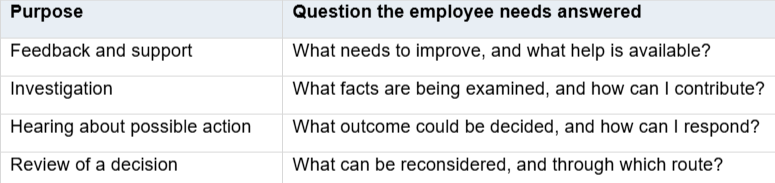
This is an explanatory map, not a universal sequence. Organisations use different procedures, and some matters require formal handling from the outset. The value of the map is that it makes the purpose visible.
Recognising a change in the process
The most useful signals concern what a meeting can decide and how its records will be used.
A manager might explain that an informal review has ended and a hearing under a named policy will follow. Earlier discussions may now form part of the evidence. A letter may identify a possible formal warning or another employment consequence. These developments justify asking for a clear account of the stage reached.
Other features are less decisive. HR may advise on early support. A manager may set objectives without issuing a warning. A review deadline may simply create a sensible point at which to assess progress. Counting these features does not produce a reliable legal test.
Consider the difference between being told that continued difficulties could lead to a separate formal hearing and being invited to a meeting that could itself issue a formal warning. The first describes a possible future step. The second identifies a decision that may be made at the meeting. That distinction matters when preparing and checking the applicable safeguards.
My recommendation to managers is to explain the change plainly. Name the procedure, explain why it is being used and say what remains undecided. Give the employee a clear way to respond.
If a discussion moves beyond its stated purpose, I would recommend pausing to clarify the next stage and any preparation needed. That is a governance recommendation; the applicable legal and policy requirements still need to be checked.
For the worker, a useful request might be: please confirm which stage we have reached and whether this meeting can decide on formal action. Asking that question is one way to prepare and engage.
Accompaniment depends on the meeting
The right to bring a companion is a good example of why substance matters.
The Acas Code explains the statutory right, on a reasonable request, at disciplinary hearings that could issue or confirm a formal warning or other disciplinary action. It also covers grievance hearings concerning a duty owed by the employer. Eligible companions include a fellow worker and specified trade union representatives or officials.
A disciplinary investigation meeting does not carry the same automatic statutory right, although Acas recommends allowing accompaniment as good practice. An employer’s procedure may provide additional support, and reasonable-adjustment duties may be relevant for a disabled worker.
When requesting a companion, also ask what kind of meeting this is, what it can decide and what the relevant procedure provides. Calling a meeting informal should not end that enquiry.
When the invitation leaves those matters uncertain, seeking clarification early gives the employer time to address the request and the employee time to prepare. An unresolved question is also a reason to obtain timely union or employment advice.
Understanding performance in healthcare
In healthcare, I would start with two questions: what happened, and what might explain it?
A concern about someone’s work needs enough detail for the person to understand and answer it.
The explanation then needs to be tested.
I would ask whether the expected standard was clear, whether preparation and resources were adequate, and what support could help. These are questions for enquiry. They do not establish the cause of an incident or remove individual responsibility where the evidence supports it.
Disability requires specific attention where relevant. Acas advises employers to discuss expectations, support and reasonable adjustments, and to consider evidence about the support provided and its effect before deciding on further action. Assumptions about a person’s capability are an inadequate substitute for that enquiry.
If you are new to a UK organisation, ask for unfamiliar terms to be explained. Capability usually concerns the ability to do the job; conduct concerns behaviour. The Acas performance guidance linked above explains that distinction.
You should be able to ask what those terms mean for your meeting. I see that understanding as part of being able to take responsibility for what happens next.
Healthcare employers may have profession-specific and local arrangements. The relevant procedure needs to be checked rather than assuming that every NHS organisation uses the same stages.
When concerns overlap
An employee may raise a grievance while a disciplinary or performance process is underway. This creates a need to explain how the issues relate, who will consider them and whether one enquiry affects the fairness of another.
The Acas Code allows a disciplinary process to be temporarily suspended to address a grievance. It also recognises that related matters may appropriately be handled concurrently. Raising a grievance therefore does not automatically stop disciplinary action.
For a separate capability procedure, the applicable policy and circumstances still require examination. The Code’s disciplinary provision should not be converted into a universal answer for every management process.
I would want the handling decision and its reasons recorded. If the processes continue together, how will the grievance be considered fairly? If one pauses, what happens next?
The employee still needs to engage with legitimate concerns about their work. Equally, raising a concern should lead to a clear explanation of how it will be considered.
Questions worth settling before the meeting
Workers and managers can use the same short preparation list:
What is the purpose of this meeting, and which procedure and stage apply?
Can this meeting decide on a warning or other action, or would that require a separate step?
What concerns and records will be considered, and how can the employee respond?
What accompaniment or other support is available?
What improvement is expected, what support is offered, and how will progress be reviewed?
How will the outcome and any applicable review or appeal route be explained?
These are practical questions, not a claim that identical rights attach to every conversation. The Acas Code supports written disciplinary and grievance outcomes and appeal opportunities within its scope. Failure to follow the Code does not alone create liability, but tribunals take it into account in relevant cases.
A worker should leave a meeting understanding more than the manager’s concern. They should understand what process they are participating in, what remains open for discussion and what happens next.
This is why understanding the process matters before a decision is made. Informal support can give someone a chance to improve. Formal procedures can be necessary. In either setting, my expectation of fair leadership is that the person affected can understand the concern, prepare a response and know what happens next.
General educational commentary about workplace processes in Great Britain, with healthcare applications. Northern Ireland has a separate framework. Individual rights depend on employment status, circumstances and applicable law and policy. This article is not legal or clinical advice. Sources may change; seek advice appropriate to your circumstances.
References
1. Acas. Problems with an employee’s performance.
Capability, conduct, improvement plans and support.
2. Acas. Investigations at work: Step 1 — Deciding to investigate.
Purpose of an investigation and possible next steps.
3. Acas. Disciplinary procedure: Step 4 — The hearing.
Advance information, preparation and the opportunity to respond.
4. Acas. Code of Practice on disciplinary and grievance procedures.
Foreword; paragraphs 1, 7, 9–17, 18–29, 35–37, 40–46.
5. Acas. Investigations at work: Step 4 — Holding investigation meetings.
Accompaniment at investigation meetings and relevant adjustments.
6. Acas. Supporting disabled people at work: Capability and performance.
Support, reasonable adjustments and performance procedures.
